This week’s project was to install a DC-DC charger which will charge the house battery from the alternator on the engine. The engine electrics all run at 12VDC with a standard car/lawn mower type battery. My house battery is a LiFePO4 with a nominal 24VDC (actually closer to 29V when fully charged).
Nate identified the alternator as having a rating of 35 amps. A rule of thumb I heard is that the DC-DC charger should be limited to about half that, so the starter battery and engine can get the power they need without overloading the alternator. I figured the Victron Orion-TR Smart charger would do the job.
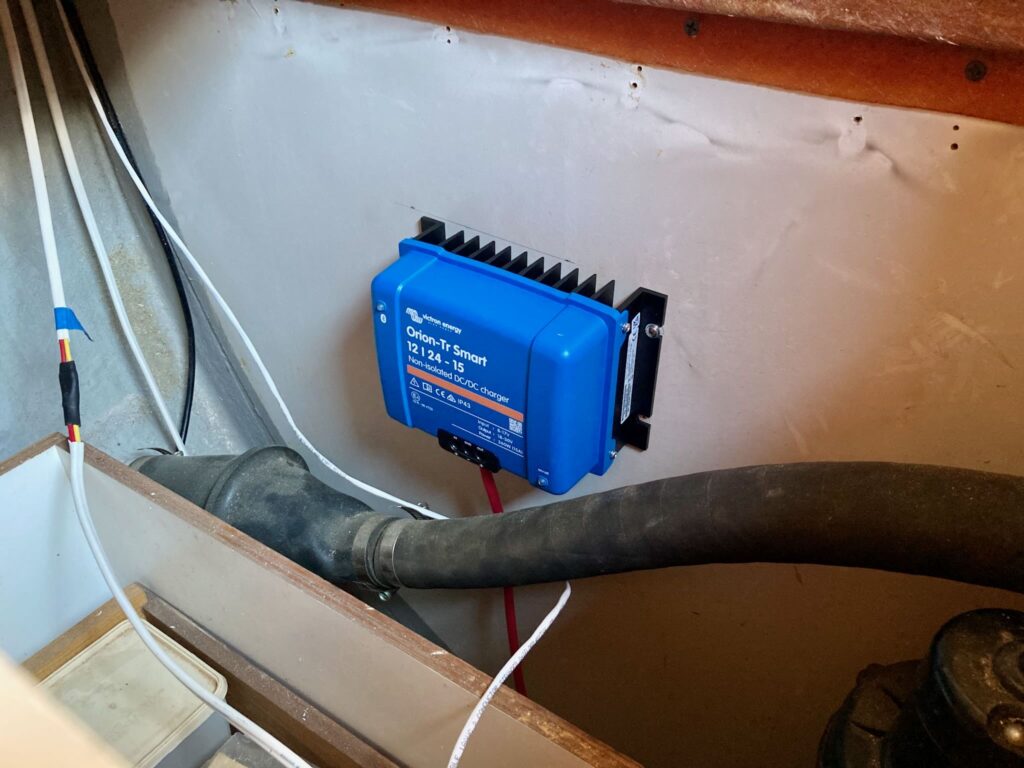
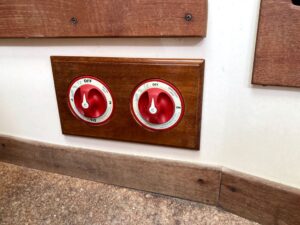
I took the opportunity to reroute some wires around the engine as well, and connect the new main disconnect switch for the engine starter battery.
The instructions from Victron suggested configuring the charger (via Bluetooth and the VictronConnect app) while it’s off and only the source power is connected. So that’s what I did. I used the charger’s internal meter to note the voltage of the system at several key points. With the engine off, the battery rested around 12.7V (good to know, the battery—purchased used—appears healthy). Within a few seconds after starting the engine, the alternator increased the voltage to around 14.0V. Over the next few minutes, presumably as the starter battery regained its charge, the system voltage increased further to 14.6V. It continued to slowly rise beyond that level as well. I used these voltages as references for programming the charger’s settings for engine run detection.
It turns out that (even as smart as it is) the charger does not have a setting to adjust the maximum charging current. I wanted to set this to draw about half of the alternator’s rating. This would be 17.5A on the 12V side, or a little over 7A at 29V. Instead, the charger will adjust the current dynamically to maintain input voltage above a certain threshold, the shutdown voltage. So for my purposes I ended up setting the shutdown voltage quite a bit higher than it might need to be otherwise. This will ensure that the alternator does not overheat and that priority will be given to the starter battery to get a good recharge right away.
For now I have to guess, because I don’t have an accurate current meter. A good battery monitor is on order, though, which will let me fine tune the charger if needed. For now, I’ve set the shutdown voltage to 14.1V. This means that the charger will not do any charging when the voltage on the engine side is below 14.1V. I also set the start voltage to 14.6V, which allows the engine starter battery to have at least partially recharged before this charger kicks on. A third parameter, start delay, I set to 14.4V with a 120 second delay. This means that if the voltage is about 14.4V for over 120 seconds, the charger will also turn on. Hopefully this results in a good balance between topping off the starter battery while also giving some current to the house battery.